
-
Bursa White Marble Sandblasted 6x12 2" Paver
Regular price $1,197.91 USDRegular price -
Bursa White Marble Sandblasted 36x36 1-1/4" Paver
Regular price $2,700.00 USDRegular price -
Bursa White Marble Sandblasted 24x48 1-1/4" Paver
Regular price $2,198.00 USDRegular price -
Bursa White Marble Sandblasted 24x36 1-1/4" Paver
Regular price $3,500.00 USDRegular price -
Bursa White Marble Sandblasted 24x24 1-1/4" Paver
Regular price $1,450.68 USDRegular price -
Bursa White Marble Sandblasted 16x16 1-1/4" Paver
Regular price $2,579.35 USDRegular price -
Bursa White Marble Sandblasted 16x24 1-1/4" Paver
Regular price $1,934.24 USDRegular price -
Bursa White Marble Sandblasted 12x24 1-1/4" Paver
Regular price $1,450.68 USDRegular price -
Bursa White Marble Sandblasted 12x12 1-1/4" Paver
Regular price $1,934.24 USDRegular price -
Bursa White Marble Sandblasted 6x12 1-1/4" Paver
Regular price $1,978.20 USDRegular price -
Bursa White Marble Sandblasted French Pattern 1-1/4" Paver
Regular price $1,934.24 USDRegular price -
Bursa White Marble Leather 24x48 2" Paver
Regular price $1,318.80 USDRegular price -
Bursa White Marble Leather 24x36 2" Paver
Regular price $3,500.00 USDRegular price -
Bursa White Marble Leather 24x24 2" Paver
Regular price $2,100.00 USDRegular price -
Bursa White Marble Leather 16x24 2" Paver
Regular price $1,960.00 USDRegular price -
Bursa White Marble Leather 12x24 2" Paver
Regular price $1,440.00 USDRegular price -
Bursa White Marble Leather 6x12 2" Paver
Regular price $1,197.91 USDRegular price -
Bursa White Marble Leather 36x36 1-1/4" Paver
Regular price $2,700.00 USDRegular price -
Bursa White Marble Leather 24x48 1-1/4" Paver
Regular price $2,198.00 USDRegular price -
Bursa White Marble Leather 24x36 1-1/4" Paver
Regular price $3,500.00 USDRegular price -
Bursa White Marble Leather 24x24 1-1/4" Paver
Regular price $1,450.68 USDRegular price -
Bursa White Marble Leather 16x16 1-1/4" Paver
Regular price $2,579.35 USDRegular price -
Bursa White Marble Leather 16x24 1-1/4" Paver
Regular price $1,934.24 USDRegular price -
Bursa White Marble Leather 12x24 1-1/4" Paver
Regular price $1,450.68 USDRegular price




White Marble Pavers: Which White, Which Finish, and What to Expect Outdoors
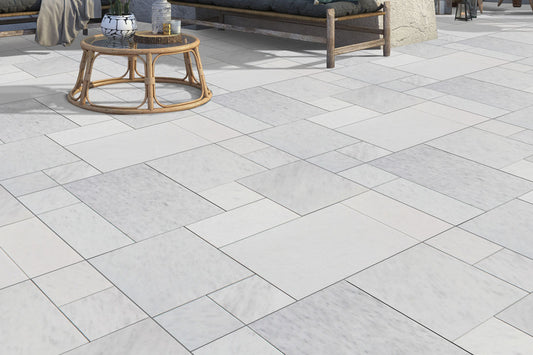
"White marble" covers a range outdoors, from a near-uniform bright white to a soft white with gray veining, and the stone you pick decides how the deck reads from the house. The bright, even whites are Ice White, Ibiza White and Bursa White, three Turkish marbles that look very alike in a photo and differ in hand: Ice White is the coolest and most uniform, Ibiza has a faint warm cast, Bursa carries a little more movement. Saranac White, Nantucket White, Laramie White, Cortez White and Whitefish White are the veined whites, with gray or taupe figure running through a white ground, and they read softer and less formal. All eight are cut in the standard sizes from 6x12 to 36x36 and in French pattern.
Finish matters more than color on a white deck
A polished white marble has no place outdoors; it is slick wet and it etches. Every white here is sandblasted, leather or tumbled. Sandblasted gives a fine matte texture with the best wet grip and the brightest, chalkiest white; leather keeps a low sheen and square edges for a formal, modern layout; tumbled softens the edges and the color for a Mediterranean look. The same stone in the three finishes is three different decks, so sample the finish, not just the color.
Heat, glare and what white hides
White marble stays cooler underfoot than any dark stone and is the right pick for a barefoot deck in a hot climate, though porous travertine still runs cooler than dense marble. The trade-off is glare: a large expanse of bright white in full sun is hard on the eyes at noon, which is why many people pair a white field with a gray or beige coping, or choose a veined white that breaks the surface up. White shows leaves and tannin stains more than beige, and it shows rust from furniture feet, so a penetrating sealer after the joints cure is not optional. It does not yellow; a sealed white marble that is rinsed now and then stays white.
Pairing and sizes
White marble pairs with charcoal, black and gray houses, with blue water, and with warm wood. Tundra Grey or a gray travertine coping against an Ice White field is the most-ordered combination. For size, 24x24 and 24x48 suit the modern look white marble usually goes with; French pattern suits the tumbled whites around a freeform pool. The marble color guide covers every white and gray side by side, and the marble cost guide covers the pallet math.
Frequently asked questions
Is white marble expensive?
Not compared with the rest of the marble line. The classic whites (Ice White, Ibiza White, Bursa White) are priced the same per square foot as the other premium marble colors in the same size and finish, and the veined whites (Saranac, Nantucket, Cortez, Laramie) sit below them. Every product page shows the per-square-foot price.
What are the disadvantages of white marble pavers?
Glare in full sun on a large deck, visible leaf and rust stains if left unsealed, and etching from acids like citrus and some cleaners. All three are managed with a penetrating sealer, a pH-neutral cleaner, and a gray or beige coping to break up the field.
Does white marble turn gray when wet?
It darkens a shade when wet, like every natural stone, and a veined white shows its gray figure more strongly. It returns to white as it dries. A sealer reduces how much water the stone takes in and shortens the dark phase. Look at a sample wet before ordering.
What is pure white marble called?
The whitest, most uniform marbles we carry are Ice White and Ibiza White, Turkish marbles with almost no veining. Thassos is the classic pure-white Greek marble but is rarely cut as an outdoor paver.
What color goes with white marble pavers?
Gray and charcoal (Tundra Grey coping, a gray house), warm wood, and the blue of pool water. A beige or gray coping against a white field is the usual way to frame the deck and cut glare.
Are white marble pavers good for a pool deck?
Yes, in a sandblasted, leather or tumbled finish. They stay cool underfoot in sun, grip well wet, and give the brightest deck available in natural stone. Seal after installation and every two to four years.