
-
Leonardo Travertine Eased Edge 16x24 2" Pool Coping
Regular price $2,347.40 USDRegular price -
Leonardo Travertine Eased Edge 14x24 2" Pool Coping
Regular price $1,744.60 USDRegular price -
Leonardo Travertine Eased Edge 12x24 2" Pool Coping
Regular price $1,440.00 USDRegular price -
Leonardo Travertine Eased Edge 16x24 1-1/4" Pool Coping
Regular price $3,872.00 USDRegular price -
Leonardo Travertine Eased Edge 12x24 1-1/4" Pool Coping
Regular price $2,904.00 USDRegular price -
Leonardo Travertine Eased Edge 6x12 1-1/4" Pool Coping
Regular price $2,904.00 USDRegular price -
Leonardo Travertine Bullnosed 16x24 2" Pool Coping
Regular price $2,347.40 USDRegular price -
Leonardo Travertine Bullnosed 12x24 2" Pool Coping
Regular price $1,440.00 USDRegular price -
Leonardo Travertine Bullnosed 6x12 2" Pool Coping
Regular price $1,760.00 USDRegular price -
Leonardo Travertine Bullnosed 16x24 1-1/4" Pool Coping
Regular price $3,872.00 USDRegular price -
Leonardo Travertine Bullnosed 12x24 1-1/4" Pool Coping
Regular price $2,904.00 USDRegular price -
Leonardo Travertine Bullnosed 6x12 1-1/4" Pool Coping
Regular price $2,904.00 USDRegular price -
Leonardo Travertine Tumbled 24x24 1-1/4" Paver
Regular price $1,054.68 USDRegular price -
Leonardo Travertine Tumbled 16x16 1-1/4" Paver
Regular price $1,875.25 USDRegular price -
Leonardo Travertine Tumbled 16x24 1-1/4" Paver
Regular price $1,406.24 USDRegular price -
Leonardo Travertine Tumbled 12x24 1-1/4" Paver
Regular price $1,054.68 USDRegular price -
Leonardo Travertine Tumbled 6x12 1-1/4" Paver
Regular price $1,438.20 USDRegular price -
Leonardo Travertine Tumbled French Pattern 1-1/4" Paver
Regular price $1,406.24 USDRegular price






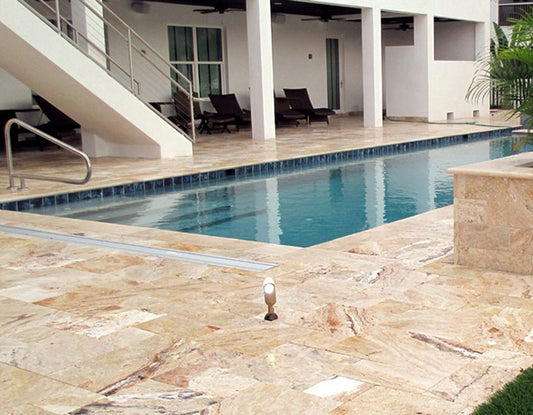
Leonardo Travertine: Warm Tones Without the Contrast
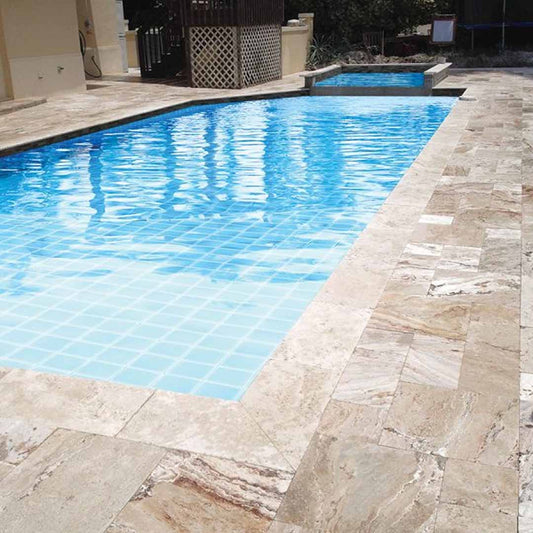
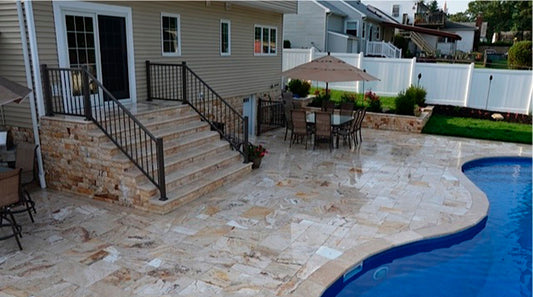
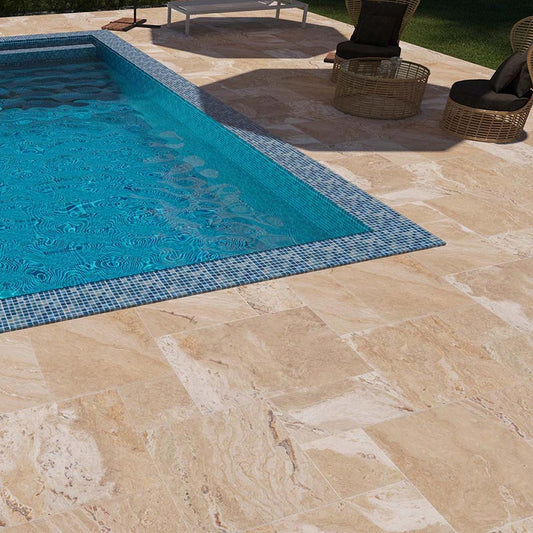
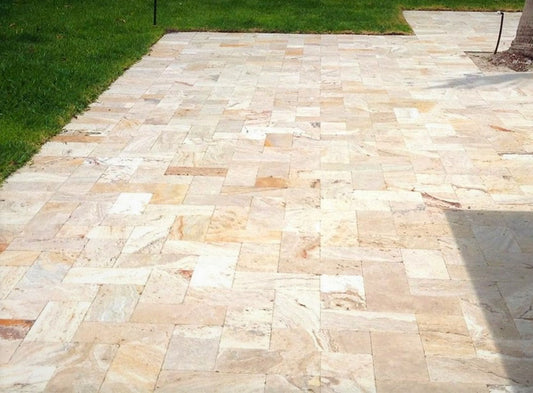
Leonardo travertine sits between Ivory and Walnut on the warmth scale. The ground is a light tan to beige, with thin darker lines running across the face in one direction, giving it a subtle linear grain rather than the mottled look of a classic blend. Pieces vary in how strong the lines are, so we list it with our multi and patterned stones, but the overall palette stays within a narrow warm band. Tumbled, it has softened edges and a matte, textured surface that stays cool in sun and gives good footing when wet.
Formats available in Leonardo
Pavers come in 6x12, 12x24, 16x24, 16x16 and 24x24, all tumbled. The 12x24 and 16x24 sizes are the deepest in the range and are the natural choice for a 12x24 running bond or a three-size ashlar. Pool coping in Leonardo is cut with either a bullnose or an eased edge in 6x12, 12x24, 14x24 and 16x24, with both 1-1/4" and 2" thicknesses listed, so a 2" coping can step down to a 1-1/4" field paver without a visible mismatch in stone. The whole pool coping lineup is available if you want to compare Leonardo against other tumbled options at the same sizes.
Where Leonardo fits
Choose Leonardo when a client wants warmth but finds Walnut too dark or Autumn Blend too busy. It works with tan brick, natural cedar, bronze window frames and darker pool finishes such as a gray or black pebble, where the light beige field makes the water color stand out. Lay the pieces so the linear grain runs the same direction throughout, ideally parallel to the longest pool edge; a crew that rotates every other piece will lose the calm look that is the reason to buy this stone. For a border, the 6x12 laid as a soldier course around a 16x24 field is the standard detail. Sealing is required as with any travertine; the sealing explainer covers timing and product types. If you are weighing travertine against a marble in a similar tone, Corsica Cream is the closest marble equivalent, and the travertine vs marble comparison lays out the practical differences on a pool deck.
Frequently asked questions
How does Leonardo compare to Ivory and Walnut travertine?
Leonardo is warmer and slightly darker than Ivory but lighter than Walnut, with fine straight veins rather than heavy mottling. If Ivory is too pale for the house and Walnut too brown, Leonardo usually lands in the middle. Order samples of all three and view them wet and dry outdoors.
Which coping sizes are offered in Leonardo?
Bullnose and eased-edge coping in 6x12, 12x24, 14x24 and 16x24, in 1-1/4 inch and 2 inch thickness. The 12x24 is the common choice for freeform pools and 16x24 for pools with long straight runs. Each listing shows pieces per pallet.
Should I lay Leonardo with the veins in one direction?
Yes. The stone reads calm because its lines run one way, so set every paver and coping piece with the grain parallel, usually along the longest pool edge. Rotating pieces at random turns the linear grain into a patchwork and loses the character you chose Leonardo for.
Can Leonardo handle freezing winters?
Tumbled travertine is used in freeze-thaw climates when installed on a well-drained base and sealed. The 2 inch pavers set on a compacted aggregate base handle winters better than thin material on a poorly drained slab. Our freeze-thaw guide covers base preparation and sealer choices.