
-
Ocean Blue Marble Sandblasted Eased Edge 24x72 2" Tread/Cap
Regular price $2,160.00 USDRegular price -
Ocean Blue Marble Sandblasted Eased Edge 24x36 2" Pool Coping
Regular price $3,500.00 USDRegular price -
Ocean Blue Marble Sandblasted Eased Edge 16x24 2" Pool Coping
Regular price $2,560.80 USDRegular price -
Ocean Blue Marble Sandblasted Eased Edge 14x24 2" Pool Coping
Regular price $1,903.20 USDRegular price -
Ocean Blue Marble Sandblasted Eased Edge 12x24 2" Pool Coping
Regular price $1,440.00 USDRegular price -
Ocean Blue Marble Sandblasted Eased Edge 6x12 2" Pool Coping
Regular price $1,920.00 USDRegular price -
Ocean Blue Marble Sandblasted Eased Edge 16x24 1-1/4" Pool Coping
Regular price $4,224.00 USDRegular price -
Ocean Blue Marble Sandblasted Eased Edge 14x24 1-1/4" Pool Coping
Regular price $3,192.00 USDRegular price -
Ocean Blue Marble Sandblasted Eased Edge 12x24 1-1/4" Pool Coping
Regular price $3,168.00 USDRegular price -
Ocean Blue Marble Sandblasted Eased Edge 6x12 1-1/4" Pool Coping
Regular price $3,168.00 USDRegular price -
Ocean Blue Marble Sandblasted Bullnosed 16x48 2" Pool Coping
Regular price $3,800.00 USDRegular price -
Ocean Blue Marble Sandblasted Bullnosed 12x48 2" Pool Coping
Regular price $1,920.00 USDRegular price -
Ocean Blue Marble Sandblasted Bullnosed 24x36 2" Pool Coping
Regular price $3,500.00 USDRegular price -
Ocean Blue Marble Sandblasted Bullnosed 16x24 2" Pool Coping
Regular price $2,560.80 USDRegular price -
Ocean Blue Marble Sandblasted Bullnosed 14x24 2" Pool Coping
Regular price $1,903.20 USDRegular price -
Ocean Blue Marble Sandblasted Bullnosed 12x24 2" Pool Coping
Regular price $1,440.00 USDRegular price -
Ocean Blue Marble Sandblasted Bullnosed 6x12 2" Pool Coping
Regular price $1,920.00 USDRegular price -
Ocean Blue Marble Sandblasted Bullnosed 16x24 1-1/4" Pool Coping
Regular price $4,224.00 USDRegular price -
Ocean Blue Marble Sandblasted Bullnosed 14x24 1-1/4" Pool Coping
Regular price $3,192.00 USDRegular price -
Ocean Blue Marble Sandblasted Bullnosed 12x24 1-1/4" Pool Coping
Regular price $3,168.00 USDRegular price -
Ocean Blue Marble Sandblasted Bullnosed 6x12 1-1/4" Pool Coping
Regular price $3,168.00 USDRegular price -
Ocean Blue Marble Sandblasted Bullnosed 4x9 1-1/4" Pool Coping
Regular price $6,000.00 USDRegular price -
Ocean Blue Marble Leather Eased Edge 24x72 2" Tread/Cap
Regular price $2,160.00 USDRegular price -
Ocean Blue Marble Leather Eased Edge 24x36 2" Pool Coping
Regular price $3,500.00 USDRegular price

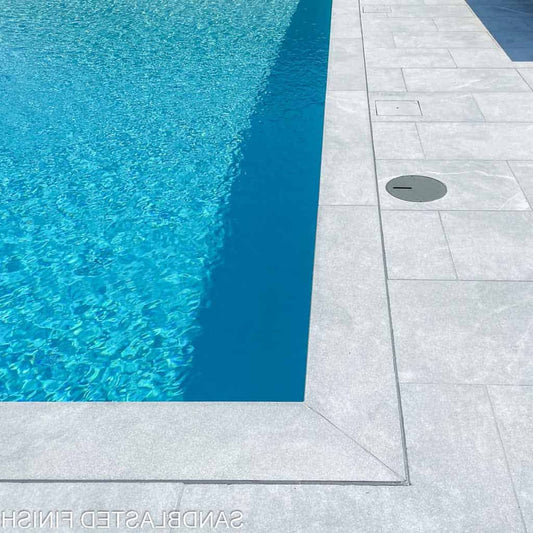

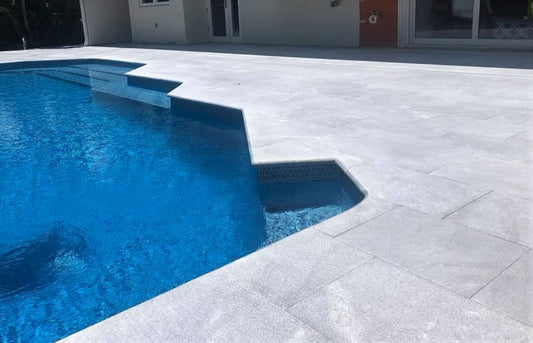

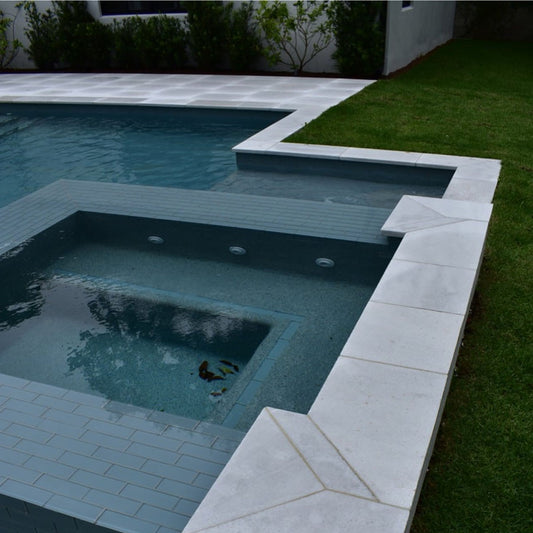
Ocean Blue marble: the blue-grey pool deck stone
Ocean Blue is the one marble in our range that reads as a color rather than a neutral. The base is a mid grey with a distinct blue undertone, crossed by bands of white and lighter grey that run roughly parallel through each slab. Laid on a deck it looks like sea water at depth, which is where the name comes from, and next to a pool the reflected water pushes the blue further. It belongs to the same family of Turkish marble as Tundra Grey but with more contrast and more movement.
Finishes and how the color shifts
The leather finish is the one that shows the blue best: brushing gives the surface a slight sheen that deepens the darker bands. Sandblasting lightens the overall tone a shade and softens the contrast, which some homeowners prefer for a large deck where a strong pattern can get busy. Wet, both finishes darken noticeably, so look at samples wet and dry. Six pieces in the 6x12 size are tumbled for a softer, rounded edge. The pool coping color guide talks through how a darker coping changes the read of the water.
Sizes in the collection
Coping: 4x9, 6x12, 12x12, 12x24, 14x24, 16x24, 24x36 and 16x48, bullnose and eased edge, plus two remodel options for resurfacing. Pavers: 12x12, 16x16, 12x24, 16x24, 24x24, 24x36, 24x48 and 36x36 at 1-1/4" or 2". Two 24x72 treads at 2" thick finish steps and seat walls. Because the banding is directional, a long piece such as the 16x48 coping or the 24x48 paver shows the stripes to full effect; if you would rather break up the pattern, set 24x24 in a running bond.
Pairing suggestions
Ocean Blue is usually the accent, not the whole job. The most common spec we ship is Ocean Blue pool coping and step treads with a lighter field of Ice White or Diane Royal pavers. For a fully grey-blue deck, run it with Tundra Grey pavers, which are quieter and cheaper to lay out because the pattern is less directional. Everything in this tone is grouped on the ocean blue color page. If the job is in a freeze-thaw region, the winter durability guide covers what to expect from dense marble outdoors.
Also sold as: Atlantic Blue is the other common trade name for this blue-gray Turkish marble. If that is the name you know, our Ocean Blue is a close match — see the distributor name cross-reference and confirm with a sample.
Frequently asked questions
Is Ocean Blue actually blue?
It is a grey marble with a clear blue undertone and white banding, not a saturated blue. In shade it reads grey-blue; in sun and near water it reads bluer. The leather finish shows more blue than sandblasted. Order a sample and view it wet, because the color deepens a lot when the surface is damp.
Does the dark color get hot?
Ocean Blue absorbs more heat than white or beige marble and will be warmer underfoot in full afternoon sun. That is one reason many builders use it as coping and accent with a lighter paver field. In partial shade or in northern climates it is used for whole decks without complaint.
How do I keep the banding consistent across the deck?
Open several crates and dry-lay before setting. Decide whether the bands run parallel to the pool or across it and keep that direction throughout. Pull pieces from multiple crates at once so any variation between blocks is spread evenly rather than showing up as a stripe of different stone.
Which coping profile suits Ocean Blue best?
Eased edge is popular because the crisp square edge suits a modern grey-blue deck and shows the banding cleanly on the face. Bullnose is the choice for a softer traditional look or a curved pool. Remodel coping with a drop face is available for covering an existing beam during a resurface.