
-
Sandy Beige Basalt Brushed 12x24 1-1/4" Paver
Regular price $1,980.00 USDRegular price -
Sandy Beige Basalt Brushed 6x12 1-1/4" Paver
Regular price $2,700.00 USDRegular price -
Sandy Beige Limestone Leather 24x24 2" Paver
Regular price $2,100.00 USDRegular price -
Sandy Beige Limestone Leather 16x24 2" Paver
Regular price $1,960.00 USDRegular price -
Sandy Beige Limestone Leather 24x24 1-1/4" Paver
Regular price $1,252.68 USDRegular price -
Sandy Beige Limestone Leather 16x24 1-1/4" Paver
Regular price $1,670.24 USDRegular price -
Sandy Beige Limestone Leather 12x24 1-1/4" Paver
Regular price $1,252.68 USDRegular price -
Sandy Beige Limestone Leather 6x12 1-1/4" Paver
Regular price $1,708.20 USDRegular price -
Sandy Beige Limestone Leather French Pattern 1-1/4" Paver
Regular price $1,670.24 USDRegular price


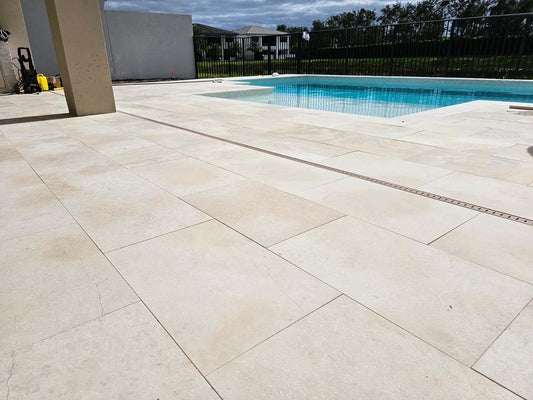


Sandy Beige: Leather Limestone and Brushed Basalt
Sandy Beige is named for its color, a warm mid-beige like damp sand, with a fine, even grain and very little veining. Most of the collection is limestone with a leather finish, which brushes the face to a soft, low-sheen texture and keeps the edges square. Two listings are brushed basalt in the same tone; basalt is a much denser volcanic stone, and the brushed finish gives it a fine matte surface with good traction. Both fall in our beige family and read as the same color on a deck, which is the point: you can use the limestone for the field and the basalt where the wear is heaviest.
What is in the collection
Nine paver listings in four sizes: 6x12, 12x24, 16x24 and 24x24. The limestone comes mostly in 1-1/4" and the 2" pieces are the basalt and the larger limestone formats. There is no coping or tread in Sandy Beige, so pool edges are usually finished with a beige marble coping from the pool coping collection; Diane Royal leather and Corsica Cream both sit close in tone. The four sizes lay out in a standard three-size ashlar (6x12, 12x24, 24x24) or a 16x24 running bond.
Where to use limestone and where to use basalt
The leather limestone is the comfortable choice for pool decks, patios and covered porches: it stays cool, feels soft underfoot and takes a penetrating sealer well. The brushed basalt is the piece for a driveway apron, a grill-station floor, a hot-tub surround where chemicals splash, or a walkway that sees carts and bikes; basalt is harder, far less porous and does not etch. Because both are the same color, a basalt border around a limestone field, or a basalt strip where a driveway meets a walkway, is nearly invisible in daylight but does the heavy work. For a lighter limestone in the same finish, Pistachio is the sister stone, with a faint green-gray cast. Seal the limestone; basalt normally does not need it. If you are weighing these against porcelain for a high-traffic area, porcelain vs natural stone lays out the tradeoffs, and the LTL freight guide explains what to expect when a mixed pallet order arrives.
Frequently asked questions
Why are there two materials in the Sandy Beige collection?
Sandy Beige is a color name. Seven listings are leather-finish limestone and two are brushed basalt in the same warm beige. The limestone is softer and cooler underfoot for decks and patios; the basalt is denser and harder for driveways, grill areas and hot-tub surrounds. Both can be combined on one project.
Do the limestone and basalt match exactly?
They are very close in color but different in texture: the leather limestone has a soft, slightly rippled surface and the brushed basalt a fine, uniform matte face. In a border or transition the difference is subtle. Order a sample of each before mixing them in the same visible area.
Does Sandy Beige basalt need sealing?
Brushed basalt is dense and low in porosity and generally does not require sealing, though a sealer can make oil and food stains easier to remove on a grill floor. The limestone pieces should be sealed with a penetrating sealer after installation, and cleaned only with pH-neutral products.
Is there Sandy Beige pool coping?
No, only pavers in 6x12, 12x24, 16x24 and 24x24. For a pool edge, use a beige marble coping such as Diane Royal or Corsica Cream, both close in tone to the limestone. Send us the pool shape and sizes with a quote request and we can suggest a coping match.