
-
Serpeggiante Limestone Leather 24x24 2" Paver
Regular price $2,100.00 USDRegular price -
Serpeggiante Limestone Leather 16x24 2" Paver
Regular price $1,960.00 USDRegular price -
Serpeggiante Limestone Leather 24x24 1-1/4" Paver
Regular price $1,252.68 USDRegular price -
Serpeggiante Limestone Leather 16x24 1-1/4" Paver
Regular price $1,670.24 USDRegular price -
Serpeggiante Limestone Leather 12x24 1-1/4" Paver
Regular price $1,252.68 USDRegular price -
Serpeggiante Limestone Leather 6x12 1-1/4" Paver
Regular price $1,708.20 USDRegular price -
Serpeggiante Limestone Leather French Pattern 1-1/4" Paver
Regular price $1,670.24 USDRegular price




Serpeggiante Limestone: Veined Pavers for Feature Areas
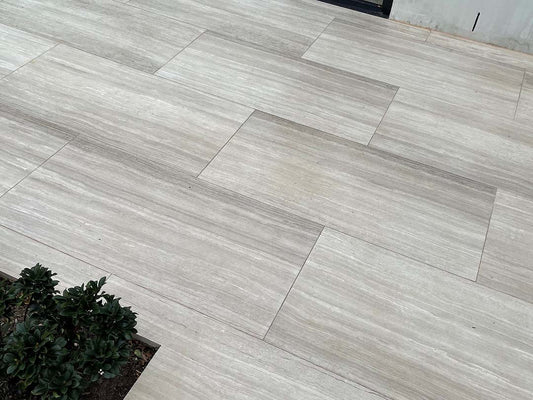
Serpeggiante — Italian for winding, and often spelled Serpegiante — is a vein-cut limestone, meaning the block is sawn across the bedding so the strata show as parallel bands rather than a cloudy pattern. The vein is the whole story. Across a light to mid-beige ground run parallel bands of darker tan and brown that wander slightly, so a laid floor shows a continuous, directional grain like sanded timber. It is a limestone, brushed to a leather finish with a soft low-sheen texture and square edges. Because the pattern is so strong we file it under multi and patterned rather than plain beige; it is a stone you specify for the look, not as a neutral background.
Formats and how to lay them
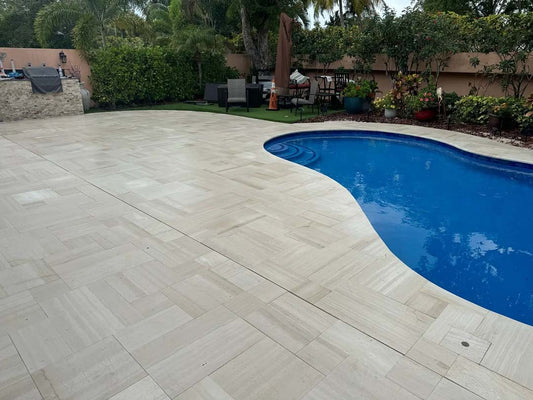
Seven pavers in four sizes: 6x12, 12x24, 16x24 and 24x24, mostly 1-1/4" with 2" on the 24x24 and 16x24. The vein runs along the length of each rectangular piece, so a 12x24 or 16x24 laid in a straight running bond with the long sides parallel to the pool gives the timber-plank effect that Serpeggiante is bought for. Rotating pieces 90 degrees, as a random ashlar would, breaks the grain into a checkerboard, so either commit to one direction or use the stone only as a feature band. A single 24x24 row or a 6x12 soldier course of Serpeggiante around a plain field gives the effect without laying a whole deck in it. There is no Serpeggiante coping; a leather pool coping in a plain beige marble such as Diane Royal keeps the edge quiet so the field pattern stands out.
Pairing and care
The natural partner is Pistachio, a leather limestone with the same finish and a calm beige-green field; Pistachio in the body and Serpeggiante as a border or a step riser is a combination that works. It also sits well next to Sandy Beige limestone and against dark gray basalt. As with all limestone, seal it with a penetrating sealer and clean with pH-neutral products; the darker veins are slightly more porous than the ground, so seal before the first season. The sealing and maintenance guide covers the schedule. Keep it to a patio, pool surround or covered porch rather than a driveway. If you are laying it near water in a freeze-thaw region, read which natural stones survive winter for base and drainage requirements before you commit.
Frequently asked questions
What does Serpeggiante look like laid out?
Laid in a running bond with all pieces oriented the same way, the parallel tan and brown veins line up piece to piece and the floor looks like brushed timber planks in stone. Laid in a random ashlar with pieces rotated, the veins cross at right angles and the effect becomes a checkerboard, so orientation matters.
Which sizes and thicknesses are available?
Serpeggiante comes in 6x12, 12x24, 16x24 and 24x24 pavers. Most are 1-1/4 inch; the 16x24 and 24x24 are also listed in 2 inch for sand-set or open-joint installation on a compacted base. Product pages show square footage and weight per pallet.
Can I use Serpeggiante as just a border?
Yes, and it is a common use. A 6x12 soldier course or a single 24x24 row of Serpeggiante around a plain beige field such as Pistachio or Myra gives the veined look at a fraction of the quantity. Order the border and field samples together to check the two tones side by side.
Is there matching Serpeggiante coping?
No. This collection is pavers only. A plain leather-finish beige marble coping such as Diane Royal keeps the pool edge calm and lets the veined field stand out. Send your pool dimensions with a quote request and we can propose a coping size and profile to suit.