
-
Pistachio Limestone Leather 24x24 2" Paver
Regular price $759.20 USDRegular price -
Pistachio Limestone Leather 16x24 2" Paver
Regular price $1,012.58 USDRegular price -
Sandy Beige Limestone Leather 24x24 2" Paver
Regular price $759.20 USDRegular price -
Sandy Beige Limestone Leather 16x24 2" Paver
Regular price $1,012.58 USDRegular price -
Serpeggiante Limestone Leather 24x24 2" Paver
Regular price $759.20 USDRegular price -
Serpeggiante Limestone Leather 16x24 2" Paver
Regular price $1,012.58 USDRegular price -
Lymra Limestone Tumbled 24x48 2" Paver
Regular price $1,138.80 USDRegular price -
Lymra Limestone Tumbled 24x36 2" Paver
Regular price $3,500.00 USDRegular price -
Lymra Limestone Tumbled 24x24 2" Paver
Regular price $759.20 USDRegular price -
Lymra Limestone Tumbled 16x24 2" Paver
Regular price $1,012.58 USDRegular price -
Lymra Limestone Tumbled 12x24 2" Paver
Regular price $759.20 USDRegular price -
Lymra Limestone Tumbled 6x12 2" Paver
Regular price $1,034.41 USDRegular price -
Symra Limestone Tumbled 24x48 2" Paver
Regular price $1,138.80 USDRegular price -
Symra Limestone Tumbled 24x36 2" Paver
Regular price $3,500.00 USDRegular price -
Symra Limestone Tumbled 24x24 2" Paver
Regular price $759.20 USDRegular price -
Symra Limestone Tumbled 16x24 2" Paver
Regular price $1,012.58 USDRegular price -
Symra Limestone Tumbled 12x24 2" Paver
Regular price $759.20 USDRegular price -
Symra Limestone Tumbled 6x12 2" Paver
Regular price $1,034.41 USDRegular price -
Myra Limestone Tumbled 24x48 2" Paver
Regular price $1,138.80 USDRegular price -
Myra Limestone Tumbled 24x36 2" Paver
Regular price $3,500.00 USDRegular price -
Myra Limestone Tumbled 24x24 2" Paver
Regular price $759.20 USDRegular price -
Myra Limestone Tumbled 16x24 2" Paver
Regular price $1,012.58 USDRegular price -
Myra Limestone Tumbled 12x24 2" Paver
Regular price $759.20 USDRegular price -
Myra Limestone Tumbled 6x12 2" Paver
Regular price $1,034.41 USDRegular price













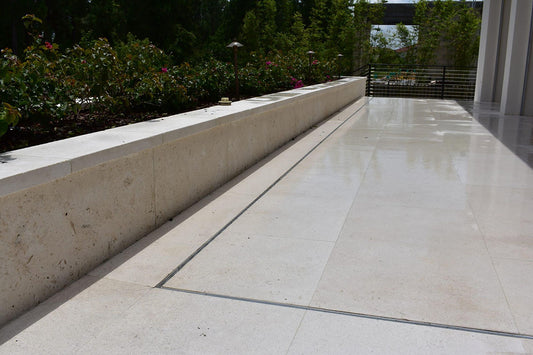


When you need 2 inch pavers, and when you do not
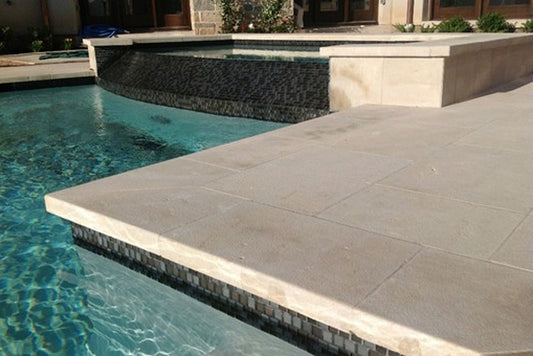
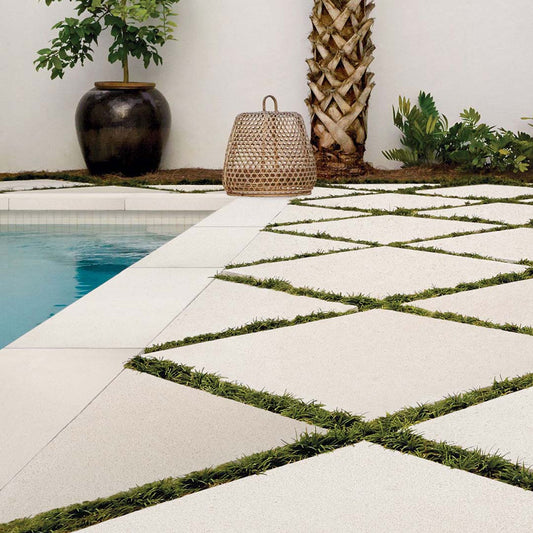
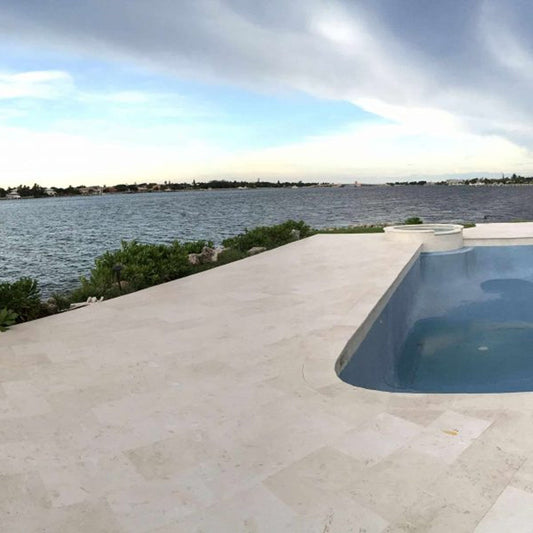
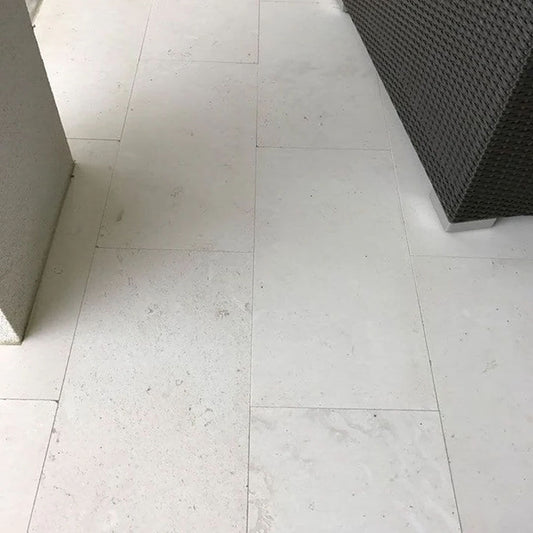
Thickness is the one spec on a paver that is difficult to correct later. Everything on this page is cut at 2", which the trade also calls 5cm. The thinner option is 1-1/4" (3cm), and the two are not interchangeable.
Specify 2 inch when
- Vehicles drive on it. Driveways, parking aprons, turnarounds and any path a truck might back over. This is the non-negotiable one.
- The pavers are sand-set. With no slab beneath, the paver itself spans the base. 2" has the mass to do that; 1-1/4" does not, and will crack at the corners over time.
- The ground freezes. Freeze-thaw cycling lifts and drops a deck all winter. 2" tolerates the movement; thinner stone fractures at the weak points.
- The format is large. A 24x48 or 36x36 has more unsupported span in the middle, so the thicker section matters more as the piece gets bigger.
1-1/4 inch is enough when
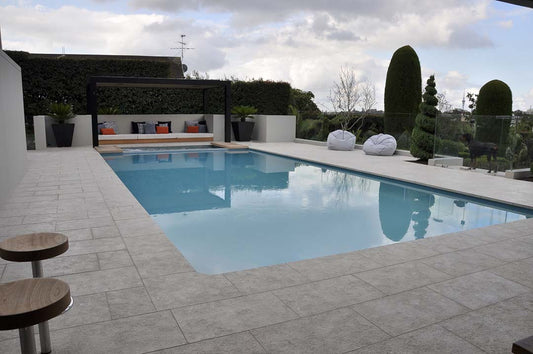
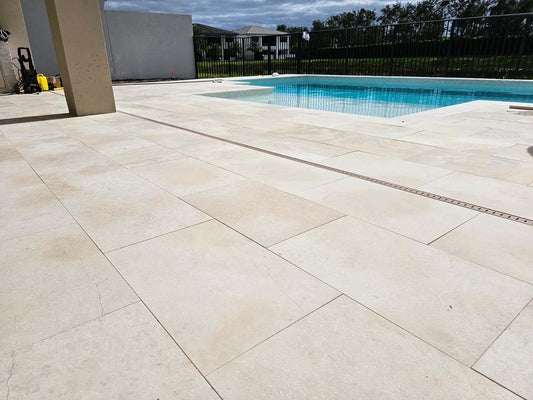
The pavers are mortar-set over a sound concrete slab, foot traffic only, in a climate that does not freeze hard. That covers a great many pool decks and patios in the South, and it is the cheaper and lighter option, with more colors and sizes available. See 1-1/4" pavers for that range. If you are between the two, 2" is the one that is never wrong; it costs more and weighs more, but no installation fails because the stone was too thick.
What 2 inch changes on site
| 1-1/4" (3cm) | 2" (5cm) | |
|---|---|---|
| Typical install | Mortar-set over slab | Sand-set or mortar-set |
| Vehicle loads | No | Yes |
| Freeze-thaw | Marginal | Yes |
| Weight per pallet | Lighter, more coverage | Heavier, less coverage |
| Handling | One person on most sizes | Two on large formats |
Because 2" stone is heavier, a pallet covers less ground than the same pallet in 1-1/4", so check the coverage figure on each product page rather than assuming. Height also matters at thresholds and around an existing pool beam: swapping 1-1/4" for 2" raises the finished deck by three quarters of an inch, which can be the difference between a door that opens and one that does not.
Materials and matching coping
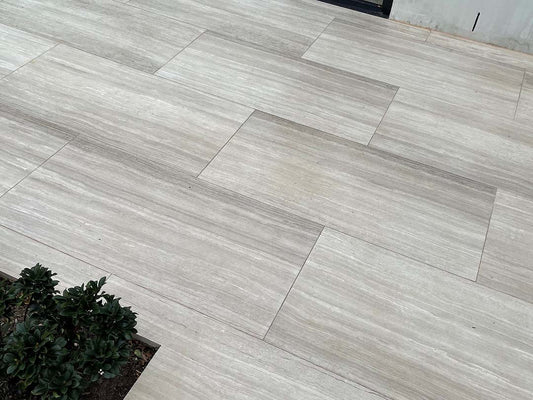
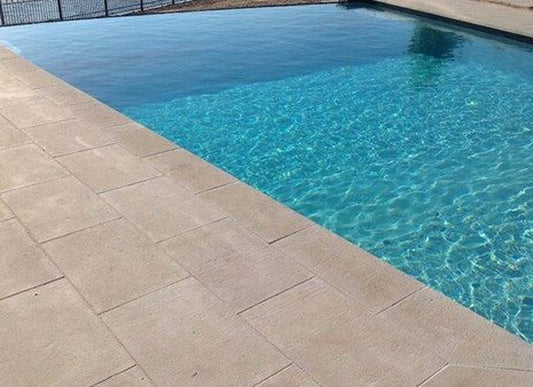
2" is available across travertine, marble and limestone. Most colors carry matching 2" pool coping so the deck and the pool edge sit flush, and 24x72 treads at 2" cover steps and seat walls. Browse by color at ivory, beige or the full stone pool coping range. The buyers guide covers base build-ups for both thicknesses, and it is worth ordering a sample before committing a pallet.
Frequently asked questions
Can I use 1-1/4 inch pavers on a driveway?
No. Vehicle loads need 2 inch (5cm). A 1-1/4 inch paver under a car will crack, usually at the corners first, and the failure is not repairable without lifting the affected area. If a driveway is in scope anywhere on the project, specify 2 inch for that zone.
Is 2 inch the same as 5cm?
Yes. 5cm is the metric designation used at the quarry and on packing lists; 2 inch is how it is specified in the US. They refer to the same stone. You will see both on our product titles and tags.
Do I need 2 inch for a pool deck?
It depends on the install. Mortar-set over an existing concrete slab in a warm climate is fine at 1-1/4 inch. Sand-set over a compacted base, or anywhere with hard winter freeze-thaw, should be 2 inch. Northern Virginia, the Mid-Atlantic and anywhere further north generally means 2 inch.
How much less does a 2 inch pallet cover?
Meaningfully less, because pallets are limited by weight rather than area. The exact coverage is listed on each product page for that size and thickness, so compare there rather than scaling from the 1-1/4 inch figure.
Can I mix 1-1/4 inch and 2 inch on one project?
Yes, and it is common: 2 inch on the driveway or a sand-set section, 1-1/4 inch on a mortar-set patio. Just plan for the height difference where the two meet, and keep each zone to one thickness rather than mixing within a field.
Does thickness change the look?
Not on the face. The color, finish and size are identical; only the edge reveal is deeper, which is slightly more visible on a sand-set install where the joint is wider. Order a sample of the color rather than the thickness if you are only judging appearance.