
-
Country Classic Travertine Tumbled 24x24 2" Paver
Regular price $1,303.20 USDRegular price -
Country Classic Travertine Tumbled 16x24 1-1/4" Paver
Regular price $1,150.72 USDRegular price -
Country Classic Travertine Tumbled 16x16 1-1/4" Paver
Regular price $723.68 USDRegular price -
Country Classic Travertine Tumbled 12x24 1-1/4" Paver
Regular price $1,292.94 USDRegular price -
Country Classic Travertine Tumbled 12x12 1-1/4" Paver
Regular price $1,219.68 USDRegular price -
Classic Light Travertine Tumbled French Pattern 1-1/4" Paver
Regular price $823.68 USDRegular price -
Classic Light Travertine Tumbled 16x24 1-1/4" Paver
Regular price $955.11 USDRegular price -
Classic Light Travertine Tumbled 12x12 1-1/4" Paver
Regular price $1,073.16 USDRegular price -
Classic Travertine Tumbled French Pattern 1-1/4" Paver
Regular price $975.04 USDRegular price -
Classic Travertine Tumbled 12x24 1-1/4" Paver
Regular price $584.76 USDRegular price -
Chesapeake Gray Travertine Tumbled French Pattern 1-1/4" Paver
Regular price $1,605.12 USDRegular price -
Chesapeake Gray Travertine Tumbled 6x12 1-1/4" Paver
Regular price $1,057.32 USDRegular price -
Chesapeake Gray Travertine Tumbled 16x24 1-1/4" Paver
Regular price $1,695.24 USDRegular price -
Chesapeake Gray Travertine Tumbled 12x24 1-1/4" Paver
Regular price $1,269.84 USDRegular price -
Camden Charcoal Travertine Tumbled French Pattern 1-1/4" Paver
Regular price $1,302.40 USDRegular price -
Camden Charcoal Travertine Tumbled 6x12 1-1/4" Paver
Regular price $1,100.18 USDRegular price -
Camden Charcoal Travertine Tumbled 16x24 2" Paver
Regular price $1,962.98 USDRegular price -
Camden Charcoal Travertine Tumbled 16x24 1-1/4" Paver
Regular price $1,304.03 USDRegular price -
Camden Charcoal Travertine Tumbled 12x24 2" Paver
Regular price $1,272.80 USDRegular price -
Camden Charcoal Travertine Tumbled 12x24 1-1/4" Paver
Regular price $976.80 USDRegular price -
Leonardo Travertine Tumbled 24x24 1-1/4" Paver
Regular price $1,054.68 USDRegular price -
Leonardo Travertine Tumbled 16x16 1-1/4" Paver
Regular price $1,875.25 USDRegular price -
Leonardo Travertine Tumbled 16x24 1-1/4" Paver
Regular price $1,406.24 USDRegular price -
Leonardo Travertine Tumbled 12x24 1-1/4" Paver
Regular price $1,054.68 USDRegular price


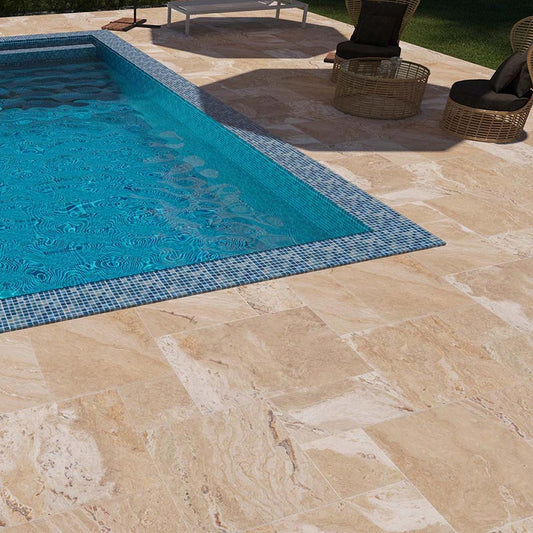

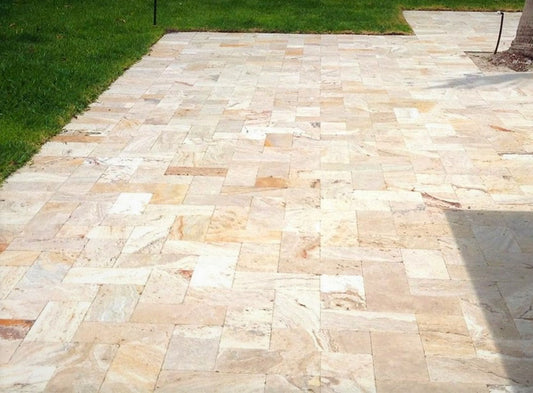
Travertine pavers: colors, sizes and how to specify them
Travertine is the most-specified stone for pool decks in the US, and the reason is physical rather than aesthetic: it is porous, so it stays measurably cooler underfoot than marble, porcelain or concrete in direct sun. This page is the paver formats only, the flat field tile. Coping, treads and wall caps in the same colors sit on the travertine hub, and the full coping range is at stone pool coping.
The core travertine colors
These nine have their own pages, with every size and profile grouped together:
| Color | Reads as | Typical use |
|---|---|---|
| Ivory | Pale cream, warmest light tone | The default pool deck; brightest water |
| Country Classic | Cream-beige with tan movement | A shade warmer than Ivory |
| Leonardo | Golden tan | Mediterranean and warm-toned houses |
| Silver | Gray with linear banding | Modern decks, cool palettes |
| Silver River | Gray with stronger vein movement | When you want visible pattern |
| Silver Alaska | Lighter, quieter gray | Calmer alternative to Silver |
| Walnut | Mid brown | Borders, or a full dark deck |
| Noce | Deeper brown than Walnut | Contrast bands and accents |
| Autumn Blend | Mixed warm tones in one pallet | Rustic, variegated decks |
Beyond those, the range now includes Extra Light, Silver Kashmir, Silver Premium, Premium Ivory, Valencia, Kayenta Gold, Ouray Beige, Galena Beige, Camden Charcoal, Chesapeake Gray, Willamette Gray, Rustic Walnut and Rushmore Black. Use the colour and finish filters on the grid above to see them, since they do not yet have pages of their own. The travertine color guide compares the core colors photographed next to water.
Every travertine here is tumbled, which leaves a matte face with rounded edges and the open pits the stone is known for. Those pits are not a defect; on a deck they add grip, and on coping they help shed splash.
Sizes and what they suit
- 6x12 and 12x12 for paths, steps and tight courtyards.
- 16x16 and 12x24 for patios where more joints help on imperfect grade.
- 16x24 is the standard pool-deck field size, laid in a one-third offset.
- 24x24 for a clean modern grid, and the most-ordered single size.
- 24x36 and 24x48 for a long plank look with fewer joints.
- 36x36 for large-format terraces; heavy enough to be a two-person set.
The French pattern sets combine four sizes into one repeating module and are supplied in travertine. They cut less waste around a freeform pool than any single large format, which is why they remain the default for curved decks.
Thickness decides more than color
1-1/4" (3cm) is for mortar-set work over a sound concrete slab carrying foot traffic in a climate that does not freeze hard. 2" (5cm) is what you need for sand-set decks, driveways and anywhere with freeze-thaw cycling, because the extra mass lets the paver span a compacted base without cracking. This is the one specification that is difficult to correct later, and how natural stone handles winter covers why.
Cost, and how it compares
Travertine pavers run roughly $4.43 to $16 per square foot depending on color and format, with most landing near $8. That sits below limestone and well below marble, and above porcelain. Full numbers with pallet math are in the travertine cost guide, and the marble cost guide has the other side if you are weighing the two. Everything is sold by the pallet with coverage printed on each listing.
Before you order
Travertine varies lot to lot, so order a sample and look at it wet as well as dry. Order the full quantity plus 10% for cuts in one go, since a later pallet from a different block will not match. Matching coping in the same color keeps the pool edge flush with the deck, and the bullnose vs eased edge guide covers profile choice. After the deck is laid, the travertine sealing guide explains what to use and when. If a supplier quoted you a trade name, the distributor stone name cross-reference shows which of our colors is the close match, and the buyers guide covers base preparation end to end.
Frequently asked questions
Why is travertine the usual choice for pool decks?
Because it is porous, which makes it stay noticeably cooler underfoot than marble, porcelain or concrete in direct sun. The same porosity gives a tumbled travertine surface good grip when wet. Those two properties are why it dominates pool decks across the South and Southwest.
Which travertine color should I pick?
Ivory is the default and the brightest against pool water. Country Classic and Leonardo are warmer if the house is brick, stucco or warm-toned siding. Silver and Silver Alaska suit cool, modern palettes. Walnut and Noce are usually borders rather than whole decks, because a dark deck gets hot.
Should I order 1-1/4 inch or 2 inch?
1-1/4 inch for mortar-set pavers over a concrete slab with foot traffic only. 2 inch for sand-set decks, driveways, and any climate with hard freeze-thaw cycling. If a driveway is anywhere in scope, that zone is 2 inch and it is not negotiable.
What size paver works best around a pool?
16x24 in a one-third offset is the most common and the most forgiving on uneven grade. 24x24 gives a cleaner modern grid. For a freeform pool, French pattern follows the curve with far less cutting than any single large format.
Do the holes in travertine need filling?
Not outdoors. The pits are left open on tumbled pavers, where they add traction and let water drain. Filled and honed travertine is an indoor product. Sand in the joints will gradually settle into surface pits on a deck, which is normal and not a defect.
How much travertine do I need?
Measure the area and add about 10% for cuts on a rectangular layout, or 15% around a freeform pool or for a pattern. Coverage per pallet is listed on every product page. Order the whole quantity at once, since natural stone varies between blocks and a later pallet will not match.